The software your music school runs on — built by a music school.
PracticePad™ is the platform behind Real Brave: 170+ active students, 31 teachers, one operator. Scheduling, tuition billing, failed-payment recovery, teacher payroll, retention analytics, and an AI Executive Assistant that answers business questions in plain language — in one system instead of five tabs and a spreadsheet.
14-day free trial · no card required · migration included
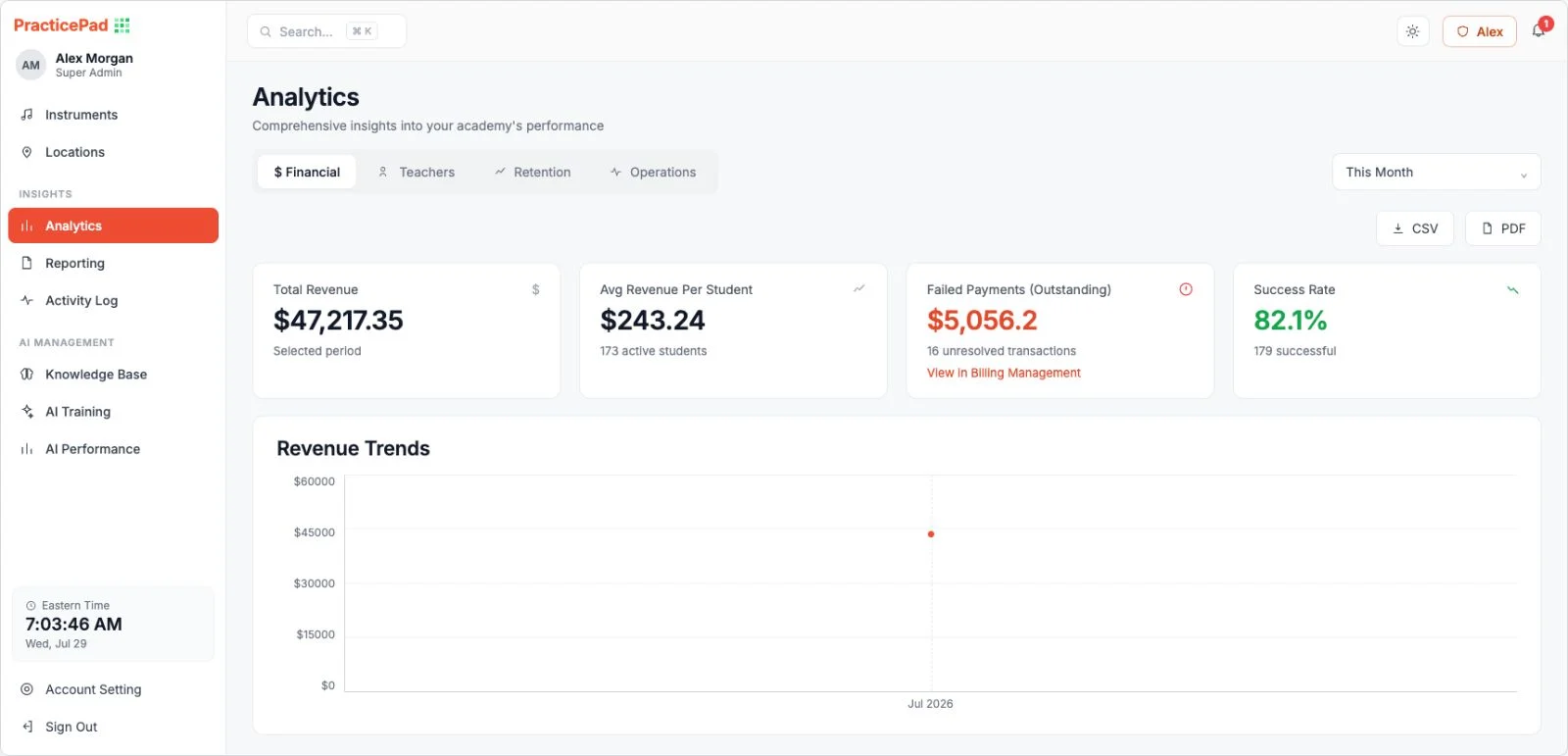
Figures from Real Brave's own PracticePad instance — the same screens shown throughout this page.
Most schools don't have a teaching problem.
They have an operations problem that quietly costs five figures a year. These are the three we built PracticePad to close.
Failed payments you find at month end
A declined card in week one is a full month of tuition gone if nobody sees it. Sixteen unresolved transactions is $5,056 sitting on the table — and at most schools nobody is watching that number daily.
Payroll rebuilt by hand every cycle
Cross-referencing a calendar against a timesheet against a rate sheet for 31 teachers is a full workday, every cycle, and it's where the expensive mistakes live.
Churn you only notice after it happens
Students don't quit suddenly — they miss, they stall, they stop practicing. Without weekly progress and attendance data, the first signal you get is the cancellation email.
Ask your school a question. Get an answer, not a report builder.
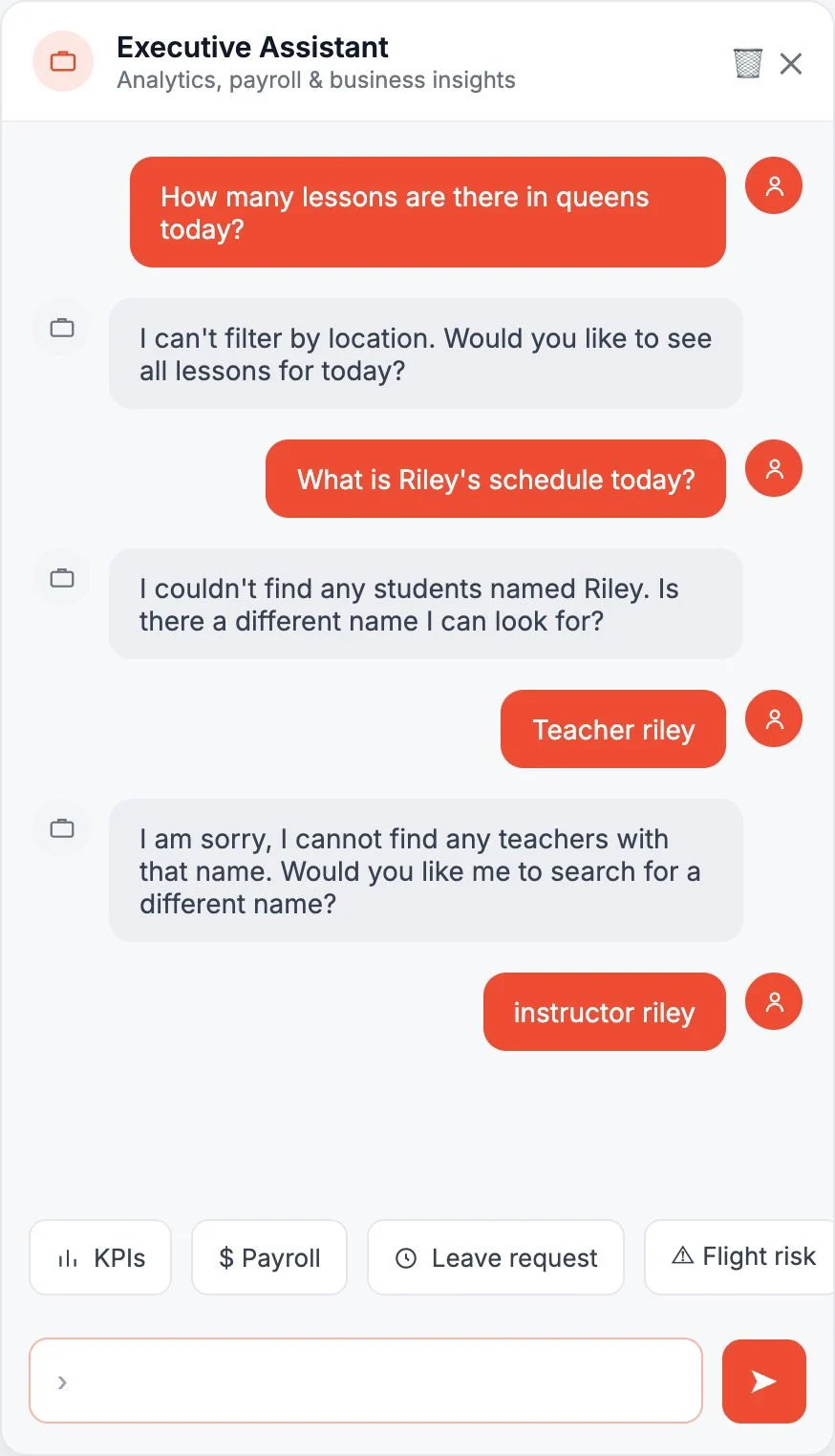
The Executive Assistant sits on your live data — lessons, teachers, payroll, subscriptions, leave requests. You type the question the way you'd ask an office manager, and it answers. No dashboards to configure, no CSV to pivot, no waiting until Friday to know where you stand.
Operational questions, instantly. Today's lesson count, who's teaching what, which rooms are open, whose leave request is still pending — answered from the same chat window.
Flight-risk detection. One tap surfaces students whose attendance and weekly skill progress are trending down, while there's still time to make a call instead of processing a cancellation.
Payroll and KPI shortcuts. Preset actions for KPIs, payroll, leave requests, and flight risk mean the four things you check every week are one tap, not four screens.
Trained on your school, and auditable. A Knowledge Base, AI Training, and AI Performance section let you feed it your own policies and see exactly how it's answering — including when it says "I can't do that," which it does instead of inventing a number.
The four numbers that decide whether your school grows.
Analytics opens on Financial and splits into Teachers, Retention, and Operations. Every view exports to CSV or PDF, so the number you saw on Tuesday is the number in your board deck on Friday.
Total revenue for the period — $47,217.35 this month, with the trend line beside it so a soft month is visible in week two, not week five.
Average revenue per student — $243.24 across 173 active students. The single fastest lever most schools ignore: raising this by $20 beats enrolling five new students.
Failed payments outstanding — $5,056 across 16 unresolved transactions, linked straight into Billing Management so recovery is a click, not an investigation.
Payment success rate — 82.1% on 179 successful charges. When this dips, you know before your bank statement tells you.
What you actually pull, and when.
Monthly close
- Revenue vs. prior period
- Revenue per active student
- Failed payments and recovery rate
- Suspended and pending accounts
- Subscription mix by tier
Payroll cycle
- Hours and completed lessons per teacher
- Earnings and commissions
- Filter by date, location, instrument
- Summary CSV for your payroll provider
- Detailed-lesson CSV for disputes
Retention review
- Attendance and no-show patterns
- Weekly skill progress by student
- Flight-risk list
- Teacher-level retention
- Cancellations by reason
A payroll cycle that takes minutes, not a workday.
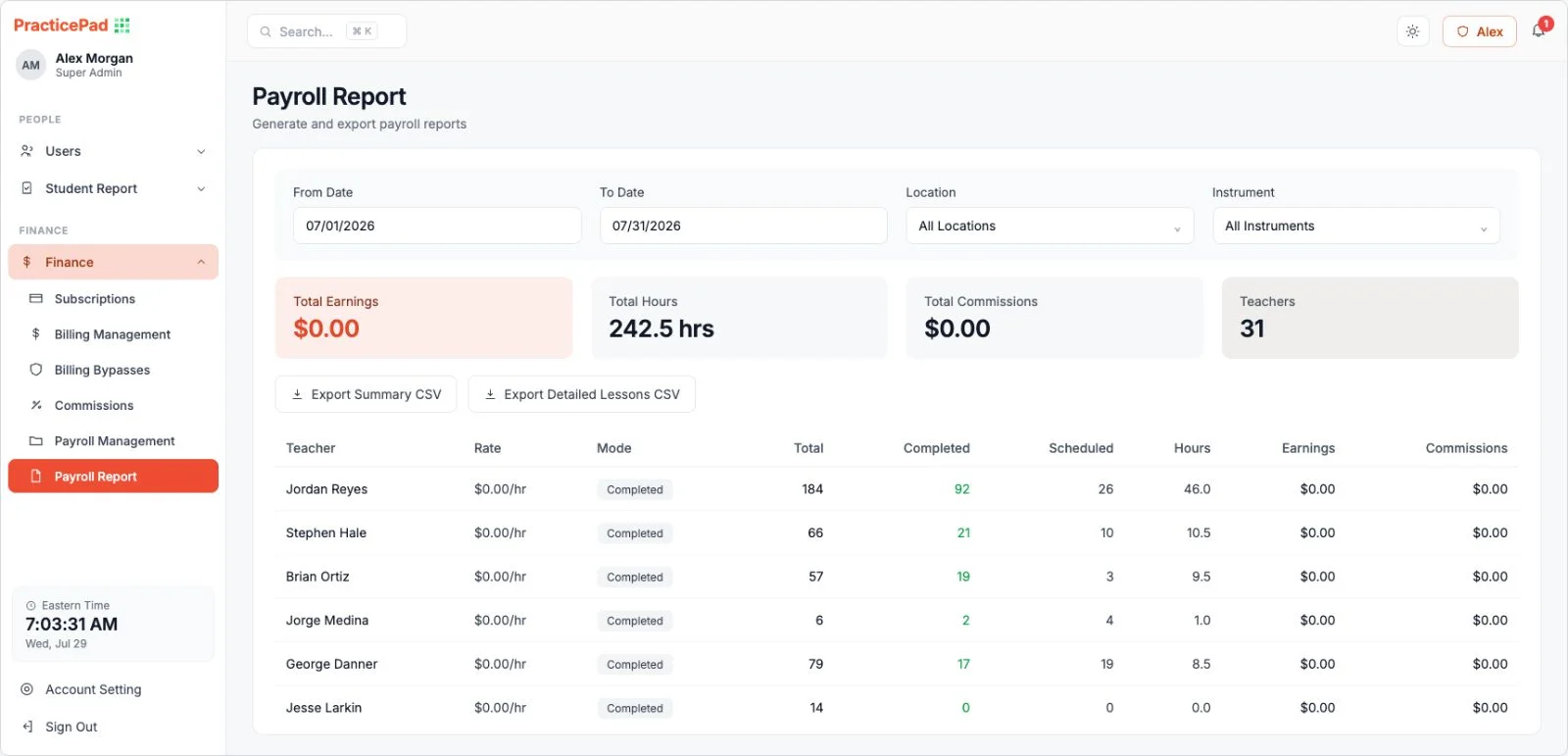
Set a date range. PracticePad reads completed lessons and returns hours, earnings, and commissions per teacher — 31 teachers, 242.5 hours, reconciled without a spreadsheet touching it.
Paid on what happened, not what was booked. Completed, scheduled, no-show, and cancelled lessons are counted separately, so a late cancel doesn't quietly become paid time.
Per-teacher rates and commissions. Hourly rate, mode, and commission structure live on the teacher record and flow straight into the report.
Filter by location and instrument. Multi-location schools can close each site independently and still see the consolidated total.
Two exports. Summary CSV goes to your payroll provider; detailed-lesson CSV settles any teacher question in thirty seconds.
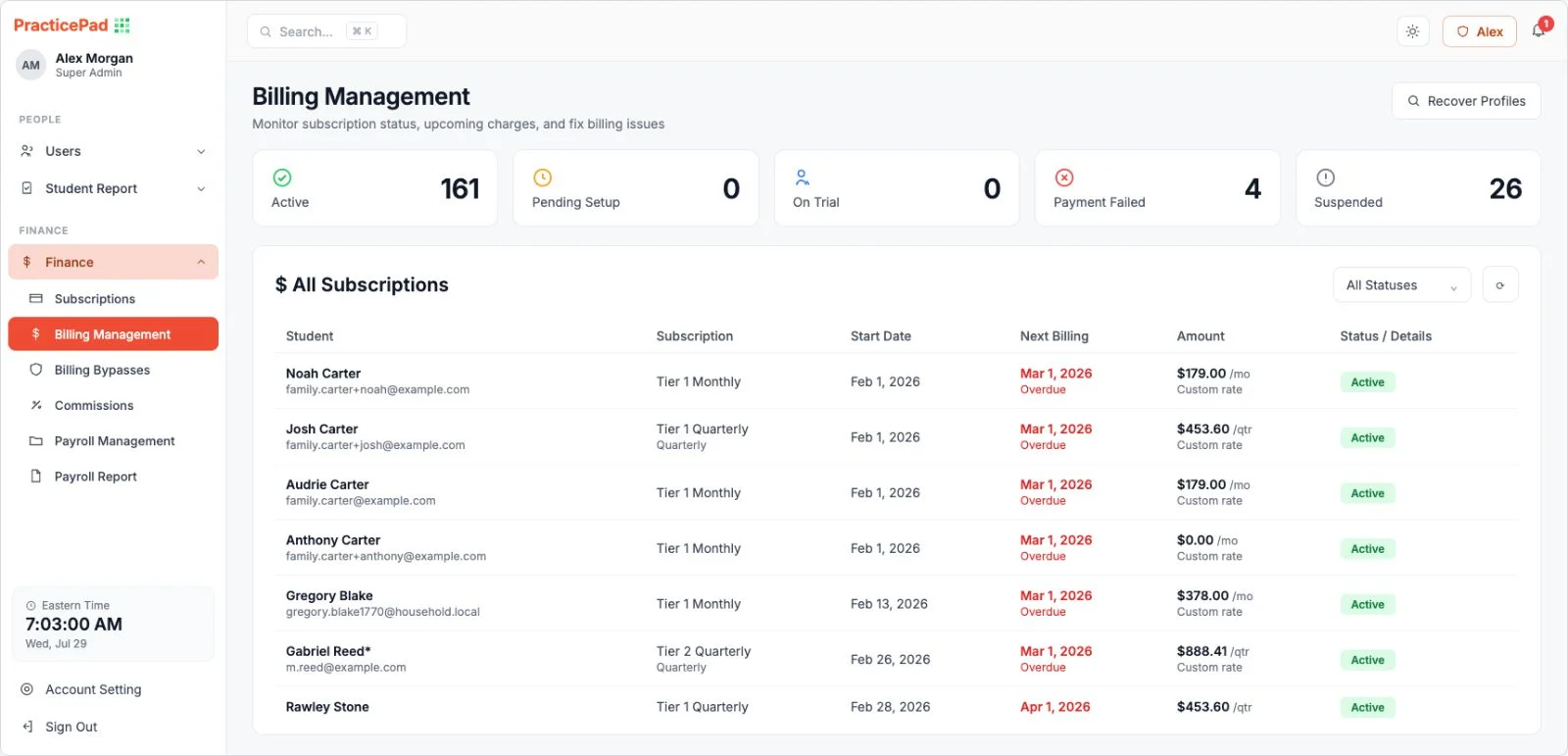
Every account, every status, one screen.
161 active, 4 payment failed, 26 suspended — visible the moment you open Billing Management, with next billing date and amount per student. Monthly and quarterly tiers, custom rates, and family accounts all in the same list.
Overdue flagged in red, by date. You chase the declined card the week it declines, not the month after.
Custom rates without leaving the system. Sibling discounts, scholarships, and legacy pricing are a field, not a side agreement in your inbox.
Billing bypasses and commissions. Handle the exceptions your school actually has — comped students, referral commissions, partner rates — with an audit trail.
Recover profiles. Bring a lapsed family back onto their old plan without rebuilding the record from scratch.
Scheduling that survives a real week.
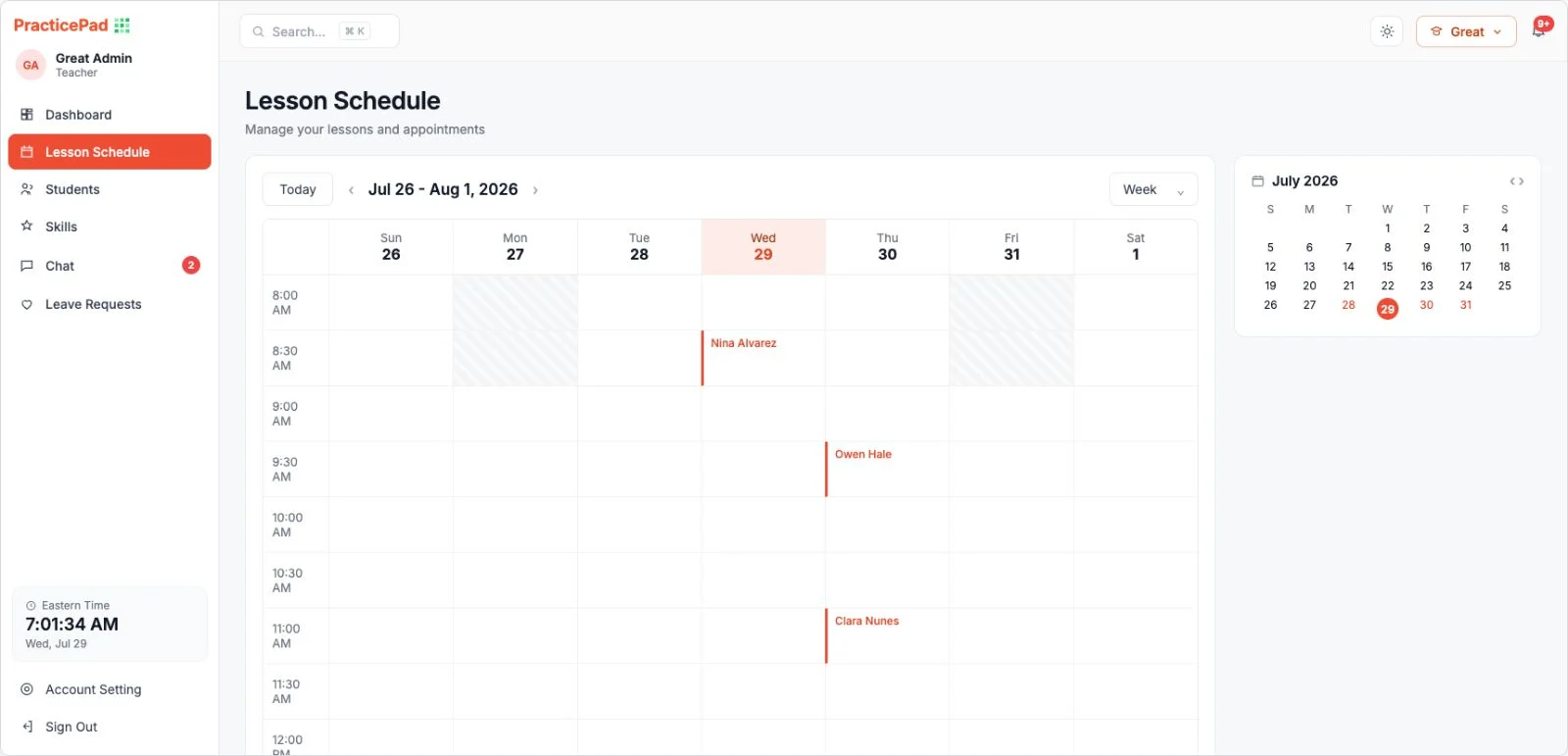
Week, day, and month views with teacher availability blocked out, recurring series, and the whole roster one click away. When a parent calls at 4:58 PM, the answer is on screen before they finish the sentence.
One lesson or 74 upcoming. Complete, early cancel, late cancel, no-show, or reschedule the single lesson — or reschedule and delete the entire future series from the same panel.
Every cancellation is typed. Early vs. late cancel vs. no-show drives both your payroll and your retention data, so policy is enforced by the software instead of by memory.
Roster with the context attached. Instrument, start date, and status per student, with skills, assessment, and messaging from the same row.
Teacher leave requests built in. Requests, approvals, and coverage live in the platform, not in a group text.
The teaching side is your retention strategy.
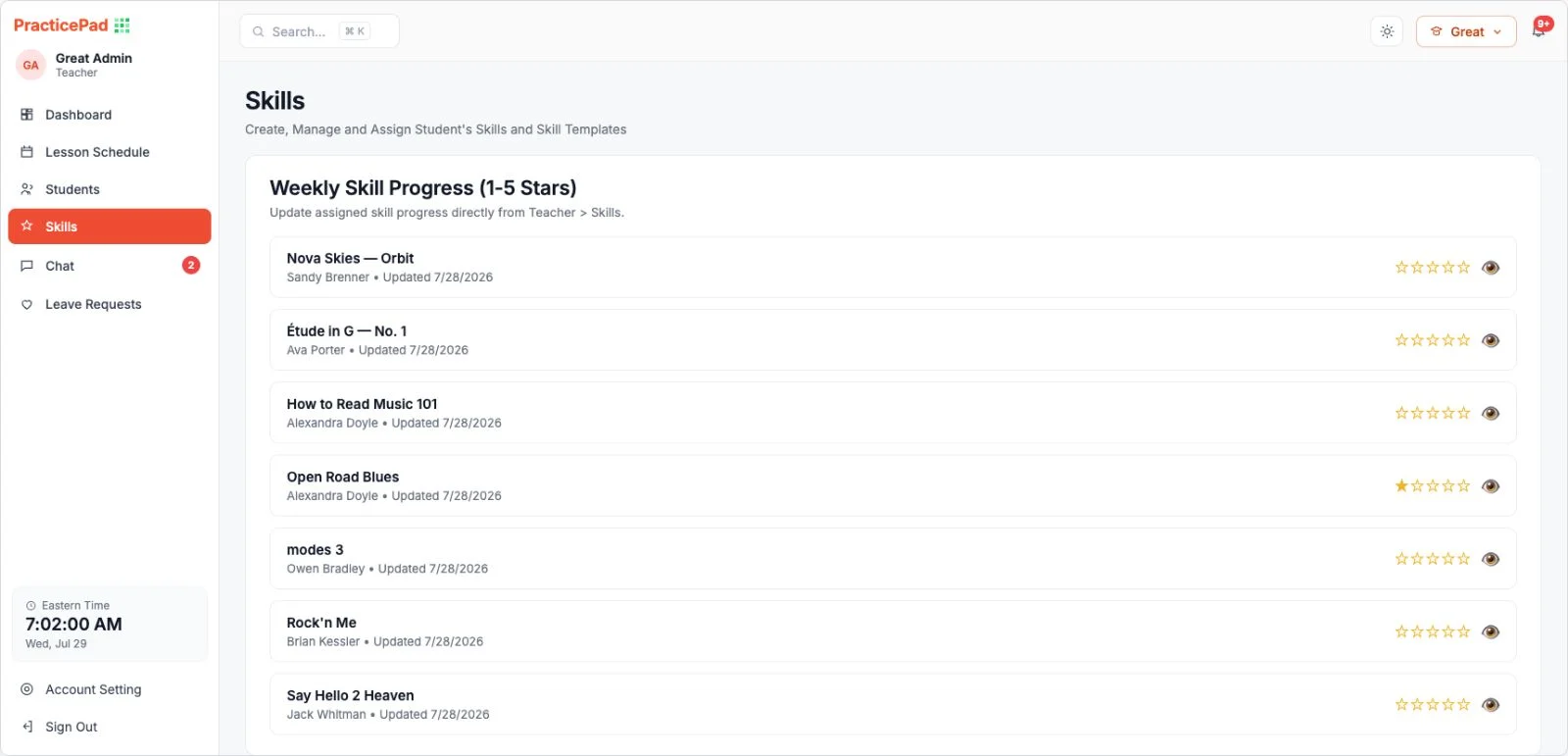
Students who can see themselves improving don't quit. Weekly 1–5 star skill ratings, assigned songs with teacher demo videos, and student response videos mean progress is documented — which is also the evidence a parent needs when they're deciding whether to renew.
Weekly star ratings per skill. Growth becomes a data series instead of an anecdote, and it feeds the flight-risk model.
Skill templates. Build your curriculum once, assign it across the school, and keep quality consistent when you hire.
Video on both sides. Teacher demos students replay all week, student submissions the teacher reviews before the next lesson.
Virtual lesson room included. Curriculum and live video in one window — add online students without adding a second platform. See the lesson room →
Live in two weeks, mid-semester, without losing a lesson.
Import
We take your roster, teachers, instruments, locations, and rates in whatever format you have them — including spreadsheets.
Rebuild the schedule
Recurring lesson series go in with real availability, so week one looks exactly like your current calendar.
Billing in parallel
Your first cycle runs alongside your old system, and we reconcile it with you before you switch off the old one.
Train the team
One session for teachers, one for admin. Teachers only need the four screens they actually use.
Straight answers.
Why trust software from a music school instead of a software company?
Because the feature list came from problems that cost us money. Real Brave runs 170+ active students and 31 teachers on this exact instance — the screenshots on this page are our live data, not a demo environment. When something in PracticePad is awkward, it's awkward for us first.
What does it replace?
For most schools: a scheduling tool, a payments processor dashboard, a spreadsheet for payroll, a separate video platform for online lessons, and the mental overhead of keeping those four in sync.
Do teachers need training?
Teachers use four screens — schedule, students, skills, and the lesson room. One session covers it. Admin and finance features are separate and hidden from teacher accounts.
Can we keep our own payment processor?
Talk to us on the walkthrough. Billing is designed around subscription tuition with monthly and quarterly cycles, custom per-student rates, and bypasses for comped students — we'll be straight with you about what your setup does and doesn't fit.
What happens to our data if we leave?
You export it. Roster, lesson history, payroll detail, and financials all export to CSV, and we'll help you pull a full extract on the way out. No hostage-taking.
Is there a contract?
No. One plan at $200 a month, cancel anytime, and migration is included rather than sold as an implementation fee.
One plan. $200 a month.
Priced per school, not per seat. No tiers to outgrow, no setup fee, no implementation invoice.
One plan. Unlimited teachers, unlimited admin logins, every feature on this page — because you shouldn't pay more for hiring or for looking at your own numbers.
- Scheduling, recurring series & leave requests
- Student roster, skills & weekly progress
- Subscription billing & failed-payment recovery
- Teacher payroll, commissions & CSV exports
- Financial, teacher, retention & operations analytics
- AI Executive Assistant
- Virtual lesson room
- Migration & onboarding included
14-day free trial · no card required · cancel anytime
Need a website to go with it? Five-page music school sites are $750.
Start your 14-day trial.
Tell us about your school and we'll set up your instance, import your roster, and walk your team through it. No card required to start.
About the school behind the software
PracticePad™ was not built by a software company. Here is the school it runs.